

Construction site security is the integrated system of physical barriers, surveillance technology, access controls, and on-site personnel that protects job sites from theft, vandalism, and unauthorized entry. Ontario construction managers face a compounding threat: equipment theft losses run between $300 million and $1 billion annually across North America, with copper theft alone adding another $1 billion per year. Those numbers represent direct project losses, delayed timelines, and insurance claims that follow a site for years. A well-built security program stops incidents before they happen and creates the audit trail needed when they do.
What are the main components of a construction site security plan?
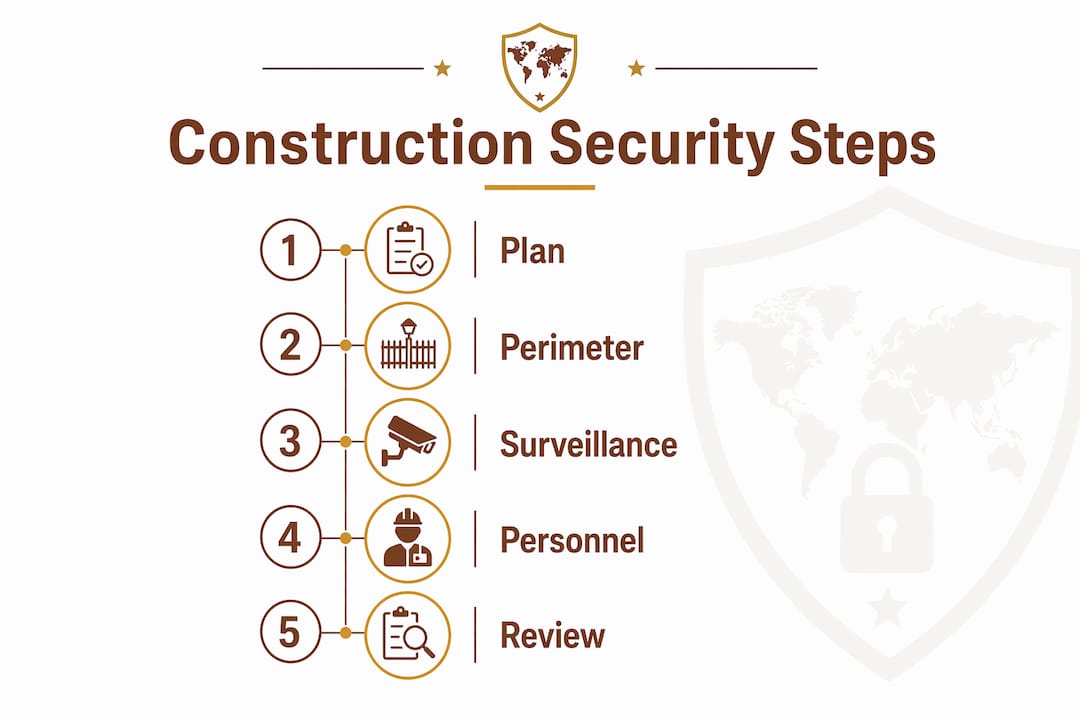
A construction site security plan is the written framework that defines every layer of protection a site will use, from the perimeter fence to the monitoring center. Without a formal plan, security decisions get made reactively, which is the most expensive way to operate.
Physical perimeter and access control
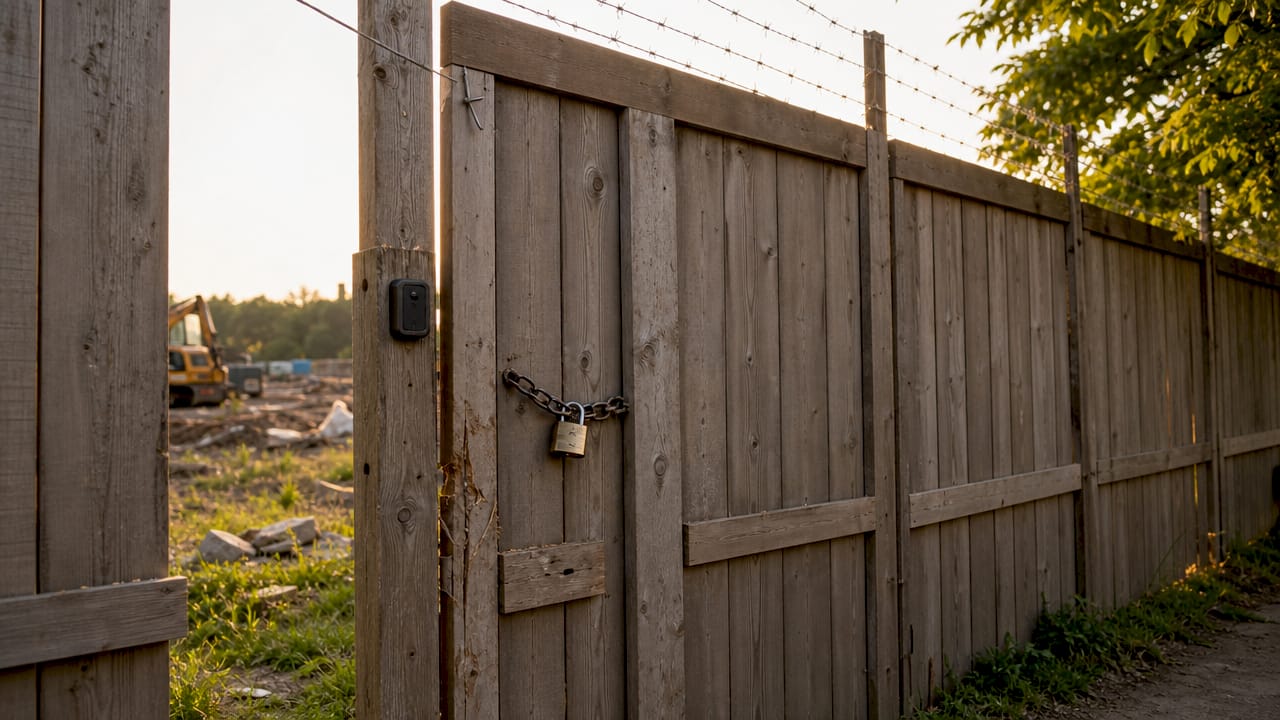
The perimeter is the first line of defense. Chain-link fencing with anti-climb extensions, locked gates, and vehicle barriers stops casual intrusion and slows determined trespassers long enough for detection systems to trigger. Credential-based entry systems reduce gate congestion and verify personnel identities, creating a record of every person and vehicle that enters or exits. Biometric readers and license plate recognition cameras take that verification a step further by removing the possibility of shared or stolen badges.
Surveillance and lighting
Security cameras for construction sites work best when paired with adequate lighting. Visible deterrents like bright lighting, warning signs, and active monitoring reduce unauthorized access attempts because intruders avoid well-lit, watched sites. Camera placement should cover entry points, material storage areas, and equipment yards. Pan-tilt-zoom cameras on towers give operators wide-area visibility without requiring dozens of fixed units.
On-site personnel and alarm systems
Technology detects. People respond. Security guard presence combined with surveillance technology creates a defense that neither element achieves alone. Guards enforce access rules, conduct patrols, and respond to alarms in real time. Alarm systems with cellular backup maintain connectivity even when site power is interrupted, which is a common occurrence during active construction phases.
Key components of a complete site security plan:
- Perimeter fencing with anti-climb features and locked vehicle gates
- Credential-based or biometric access control at all entry points
- CCTV cameras with night vision covering storage and equipment zones
- Motion-activated lighting across the full perimeter
- Alarm systems with cellular backup and 24/7 monitoring
- On-site or mobile security guard patrols
- Visible warning signage at all access points
Pro Tip: Write your security plan before breaking ground. Retrofitting access control infrastructure after concrete is poured costs three to five times more than installing it during site preparation.
How does temporary infrastructure shape construction site security solutions?
Temporary infrastructure is the defining constraint of construction site surveillance. Unlike a finished building with conduit runs, IT closets, and stable power, a job site changes weekly. Walls move, power sources shift, and network access is inconsistent at best.
Traditional wired camera systems fail in this environment. Cameras on active job sites must operate independently with on-camera analytics and cellular uplinks because standard network video management systems and passive monitoring cannot meet the demands of a live construction environment. That means the camera itself processes video locally, sends alerts over a cellular connection, and does not depend on a site server that may not exist yet.
Solar power solves the energy problem. Solar-charged camera towers can be repositioned as the site grows, following high-value equipment and materials through each project phase. Edge AI inference cameras add another layer by analyzing footage locally and triggering alerts only when a genuine threat is detected. That approach cuts false alarms dramatically compared to motion-only systems.
Weather hardening matters more than most managers expect. Dust, vibration, temperature swings, and moisture destroy consumer-grade equipment within weeks. Professional security systems use weather-hardened, tamper-resistant cameras rated for outdoor industrial environments. The upfront cost difference between consumer and professional equipment is small compared to the cost of replacing failed units mid-project.
Temporary infrastructure security checklist:
- Use solar-powered camera towers that can be repositioned as the site evolves
- Specify cameras with built-in cellular uplinks and edge AI analytics
- Confirm IP66 or IP67 weather ratings on all outdoor devices
- Set up mobile alert routing so superintendents receive notifications directly
- Plan camera placement around the project schedule, not just the current site layout
Pro Tip: Ask your security vendor for the camera’s ingress protection rating before signing any contract. An IP65-rated unit handles dust and water jets. Anything below IP65 is not appropriate for an active Ontario construction site.
What best practices minimize theft, vandalism, and unauthorized access?
The most effective theft prevention strategy uses layered defenses rather than a single control. No fence stops every intruder. No camera catches every incident. Combining multiple overlapping controls creates a system where defeating one layer still leaves several others intact.
Start with a phased, risk-based access map. Phased deployment starting with main gates and expanding to secondary zones reduces risk and adapts to project complexity as it grows. Map your highest-value assets first: generator sets, copper wire spools, heavy equipment, and fuel storage. Secure those zones before addressing lower-priority areas.
Use auditable access credentials. Every worker, subcontractor, and delivery driver should enter on a registered credential. Auditable access records support insurance claims, incident investigations, and regulatory audits. A site that cannot say who was present during an incident has a serious liability problem.
Conduct continuous risk assessments. A security plan written at groundbreaking is outdated by the time the foundation is poured. Schedule monthly reviews that account for new subcontractors, new materials on site, and changes to the site layout. Update camera positions and patrol routes accordingly.
Coordinate technology with personnel. Cameras and alarms generate alerts. Guards and alarm response teams act on them. The gap between detection and response is where losses happen. Define response protocols in writing and test them with your security provider before an incident occurs.
Maintain visible deterrents throughout the project. Signage stating that the site is monitored 24 hours a day, combined with visible cameras and lighting, deters opportunistic theft. Most construction theft is opportunistic, not organized. Removing easy opportunities removes most of the risk.
Pro Tip: Schedule one unannounced perimeter walk per week at varying times, including after dark. You will find gaps in lighting, unlocked gates, and camera blind spots that daytime inspections miss every time.
How does construction site security affect safety compliance and insurance costs?
Security and safety are not separate programs on a construction site. They share infrastructure, data, and outcomes. OSHA’s Fatal Four account for nearly 40% of construction deaths, and AI surveillance cameras can detect fall hazards and slip conditions in occupied zones. That means the same camera network protecting your equipment also generates data relevant to OSHA compliance and incident investigation.
The insurance connection is direct. Insurance premiums for construction projects range from 2% to 12% of total construction cost, and underwriters use loss-cost models to set those rates. Documented security controls, including access logs, camera coverage maps, and guard patrol records, give underwriters evidence that the site is actively managed. That evidence reduces the loss-cost estimate and, by extension, the premium.
Owner-controlled Insurance Programs (OCIP) and Contractor-controlled Insurance Programs (CCIP) both reward sites with strong loss prevention records. Access management solutions provide auditable trails that support insurance compliance and incident investigations. A site that can produce a timestamped access log and camera footage from the moment of an incident settles claims faster and at lower cost than one that cannot.
“Secure access is as much about auditability and compliance as physical prevention. The audit trail you build today is the evidence you need tomorrow when an insurer, regulator, or attorney asks what happened on your site.”
| Security control | Insurance and compliance impact |
|---|---|
| Auditable access logs | Supports incident investigation and OCIP/CCIP claims |
| 24/7 camera coverage | Provides timestamped evidence for liability disputes |
| AI fall detection | Demonstrates OSHA Fatal Four mitigation to underwriters |
| Guard patrol records | Documents active loss prevention for premium review |
| Perimeter lighting | Reduces opportunistic theft claims and incident frequency |
Key Takeaways
A layered construction site security program combining physical controls, surveillance technology, auditable access management, and trained personnel is the most effective way to reduce theft, satisfy insurance requirements, and maintain OSHA compliance on Ontario job sites.
| Point | Details |
|---|---|
| Theft risk is measurable | Equipment theft losses reach $1 billion annually, making prevention a direct financial priority. |
| Temporary sites need purpose-built tech | Solar-powered, cellular-connected cameras with edge AI are the standard for active job sites. |
| Phased deployment works best | Start security at main gates and expand to secondary zones as the project grows. |
| Auditability reduces insurance costs | Access logs and camera records lower loss-cost estimates and support faster claims resolution. |
| Guards and technology together | Human response paired with surveillance closes the gap between detection and action. |
What I’ve learned from watching Ontario sites get security wrong
Most construction security failures I’ve seen share one root cause: managers treat security as a one-time setup rather than an ongoing program. They install a few cameras at groundbreaking, hire a guard for the first month, and then assume the site is covered. By the time a theft or vandalism incident happens, the cameras have shifted out of position, the guard contract has lapsed, and there is no access log to review.
The second most common mistake is using consumer-grade equipment to save money upfront. A $200 camera from a retail store will not survive six months on an Ontario construction site through freeze-thaw cycles, concrete dust, and vibration from heavy equipment. The replacement cost, plus the footage gaps during downtime, always exceeds what a professional system would have cost.
What actually works is treating security as a project management function. Assign a specific person to own the security plan. Schedule monthly reviews the same way you schedule progress meetings. Tie camera repositioning to the project schedule so coverage follows the work. And use a provider with AI-assisted guard monitoring that gives you real-time visibility into what is happening on site, not just a report after the fact.
The Ontario construction market is competitive enough that project delays and theft losses can erase a project’s margin entirely. The sites that protect their margins are the ones that treat security as infrastructure, not an afterthought.
— Lakhwinder
Bootssecurity: site security built for Ontario construction
Ontario construction managers need a security partner that can deploy fast and adapt as the project evolves. Bootssecurity deploys guards to a site within 4 hours of contact, which matters when a threat is active or a project timeline cannot wait for a slow procurement process.

Bootssecurity combines trained security guard services with AI facial recognition, advanced surveillance systems, and a full ERP management platform that gives managers real-time visibility into guard activity and incident logs. The result is a security program that works as hard as your crew does, from groundbreaking through final inspection. Request a custom security quote tailored to your site’s specific layout, timeline, and risk profile.
FAQ
What is construction site security?
Construction site security is the integrated system of physical barriers, surveillance cameras, access controls, and security personnel that protects a job site from theft, vandalism, and unauthorized entry. It also supports OSHA safety compliance and insurance documentation.
How much does construction theft cost annually?
Equipment theft losses range from $300 million to $1 billion annually, with copper theft adding another $1 billion per year. These losses directly affect project budgets, timelines, and insurance premiums.
What cameras work best on a construction site?
Weather-hardened cameras with cellular uplinks and edge AI analytics are the standard for active construction sites. Consumer-grade cameras lack the durability and connectivity needed for temporary site infrastructure.
How does site security affect insurance premiums?
Construction insurance premiums range from 2% to 12% of total project cost. Documented security controls, including access logs and camera coverage, reduce the loss-cost estimates underwriters use to set those rates.
How often should a construction site security plan be updated?
A site security plan should be reviewed at least monthly and updated whenever the site layout changes, new subcontractors arrive, or high-value materials are delivered. Static plans become outdated quickly on active job sites.


